The Museum of Liverpool recently hosted an exhibition called ‘Double Fantasy’ charting the very public relationship and life of John Lennon and Yoko Ono. In this already Beatles-saturated city it was hardly something to salivate over but as my mum was in town we paid a visit.
As a loop of the piano introduction to Imagine boomed out at the entrance to the exhibition, it was clear that we were in familiar heritage territory. Anyone with an interest in popular music/culture already knows the story and iconography of this couple well, as documenting themselves was their stock-in-trade. In fact there is something quite contemporary about the way they documented themselves constantly for the world’s media (these days it would be social media and the Bed-In would be just another selfie fighting for attention). But ultimately there was little to learn from the predictable guitars, clothing and photos on display.
The exiting thing for me was a wall devoted to Yoko’s original typed pages of her book ‘Grapefruit’. In the early 60s, before she met Lennon, Yoko was a prominent figure on New York’s conceptual art scene staging performance pieces and collaborating with other avant-garde luminaries such as musicians Lamonte Young and Terry Riley.
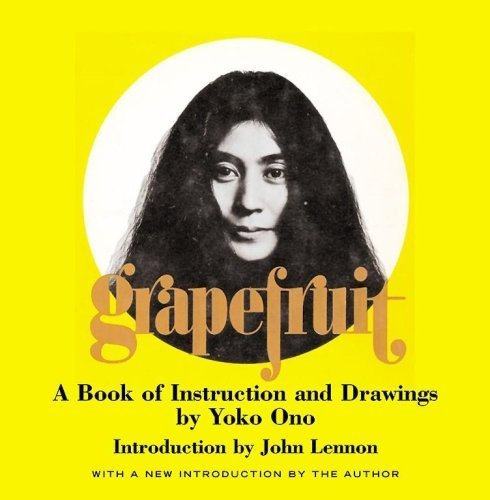
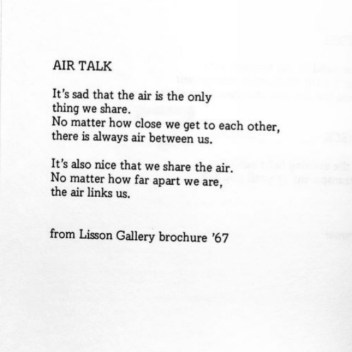
As part of her art practice, Yoko began writing ‘event scores’ which were instructions for performance art pieces, written as witty and playful minimalist poems. Eventually she collected these pieces of writing and published them in 1964 as ‘Grapefruit’, re-releasing the book in 1970 with an introduction by John Lennon.
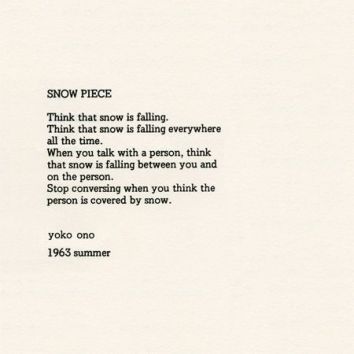
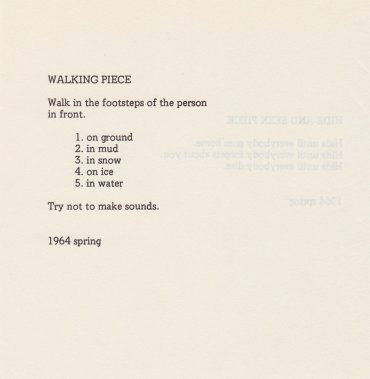
The original typed pages in a line along one wall were a treat to read. Whether or not one would choose to act out any of these pieces, they can be taken as a guide on how to live playfully, with a child-like sense of wonder and individualistic mischief.
The influence of her Japanese background is surely key, as the pieces have a mystery and open-ended character that is characteristic of Zen sayings or ‘koans’ that are designed to open the mind.
Yoko’s artistic sensibility was hugely influential on John Lennon, seeding an entirely new side to his artistic character. It’s not hard to imagine that he named the Beatles own record label after the apple that she exhibited in the exhibition where they met in 1966.